

Industry news
State of live music industry - case study
Brandon Chiat | 4 Apr 2014 7:48 AM
New Orleans musicians – like most professional touring artists – have become increasingly dependent on live performance as their primary source of income. However, the emergent trends in music technology have changed how artists approach this business model.
The global music industry has transitioned into the digital space with web-applications and mobile-platforms dominating production, distribution, and marketing. While major record labels are fighting to retain control over the industry, independent artists now have the opportunity to seize their own destiny and guide their career trajectory.
However, just because the means of production and promotion have been made available to the independent artist, doesn’t mean that these artists understand the necessary best practices to realise success.
Our good friends over at Sweet Home New Orleans have crunched the numbers and reached some eye-opening conclusions about the state of the New Orleans music scene. Sure, this is just one musical community in a much larger ecosystem, but New Orleans, with its wide-range of touring artists and well-established culture brand, is perhaps the best barometer from which to gauge the live music industry at large.
Issue is web-illiteracy
72% of New Orleans musicians have recorded, published, and distributed their music but of those artists 69% are not signed with a label. Conversely, of those artists signed to a label an astounding 88% do not receive royalties.
The internet has produced a range of tools that can supplement if not outright replace the roles formerly filled by major labels. However, just because these resources are available does not mean they are being properly utilised. Sweet Home found that 56% of New Orleans-based artists do not have an MP3 available and 54% don’t have a press kit.
The issue is web-illiteracy. Musicians, especially independent artists, must educate themselves and embrace digital tools into their business practices.
While boutique-style professional support is available, it remains limited and is not ideal for a struggling artist that is on the rise. Management teams, agents, attorneys, producers and marketers exist to maximise the potential of an aspiring artist. However, in oversaturated live markets, professional teams can be an expensive asset against already limited profits.
Again, the solution is to adopt digital platforms. Digital income streams and marketing strategies are significantly underutilised. This is a key area for independent artists as entry costs are low and access to national and international audiences could yield significant returns.
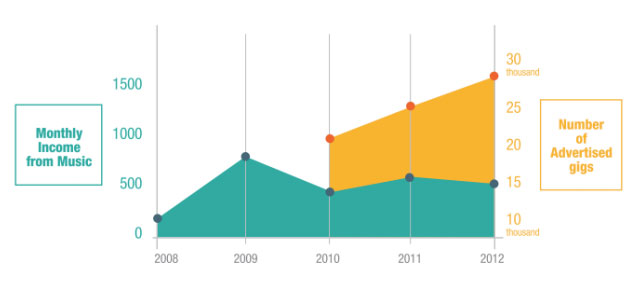
Fan engagement through advertised gigs
Intuitively, as the number of advertised gigs increases, so too does the independent artist’s monthly income generated from those gigs. Still, Sweet Home found that only 27% of New Orleans musicians have professional managers, only 22% work with professional booking agencies, and fewer than 15% work with professional promoters. Obviously there is a gap between the industry demands of gig awareness and concert discovery versus the means to generate that exposure.
New Orleans artists primarily promote their gigs and grow their fan base through word-of-mouth marketing, a tactic embraced by most emerging artists. A combination of low promotion and a near universal lack of fan email lists and other engagement methods severely limits an artist’s earning potential. This trend can be observed across the national and international music industries as well where a lack of analytical insight into an artist’s fan base is a critical limitation. Accordingly, these artists are ill-equipped to turn a one-time fan, into a long-term fan.
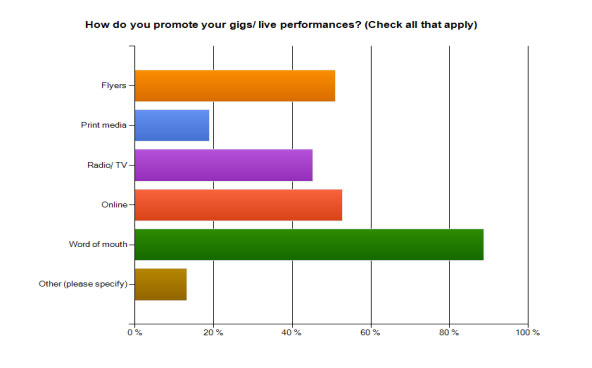
Fan engagement and concert discovery through promotion
This is exactly the problem we’re addressing with Marquee. Fan engagement, also known as direct-to-fan marketing, is a vital tactic that must be adopted by any artist, independent or major, looking to realise breakout success in the digitalised live music industry. The services once provided by industry professionals, specifically promotion and marketing, can now be executed in-house with a service like Marquee.
Marquee allows artists to gain real-time insights into their fan base and target their messages and content to the fans who will be most likely to attend shows, purchase merchandise, and promote the band through social networks and word-of-mouth. Marquee accomplishes this by creating contextual experiences through which artists adopt a “fan-first” model of concert promotion.
For more info, go to www.marquee-mobile.com.
[Brandon Chiat]
Brandon Chiat is the founder and CEO of Marquee, a service that allows independent musicians to engage their fans through exclusive rewards and experiences.