


How to
How to intelligently use mailing lists, gig guides
David Chislett | 30 Sep 2014 6:33 AM
One of the critical tools at a band’s disposal is your own database of people who have agreed to give you their contact details and who you can therefore talk to directly using email and mobile.
This database, or mailing list, is something that you will build up over time through gigs, online activity and networking and is something that every member of the band needs to pay attention to.
Firstly, the band members must put their heads together in one go and start a list with the email addresses of their friends and family who want to be kept up to date on news and live performances. Make two separate lists, one with cellphone numbers and one with email addresses.
Direct marketing
Enter them all into a spreadsheet so that you can keep track of them. Then the trick is to turn those few names into thousands, by encouraging other people to sign up to your mailing list so that you can talk to them. This kind of direct marketing is probably the most powerful way you have of developing your name and reputation. One, because you are talking directly to actual individuals who asked to hear about you and two, because this is the kind of communication that goes viral: that is, that the recipients of this kind of conversation are likely to forward it to their contacts and so on and so on, spreading your message far beyond the reaches of your original list. Just as on Facebook, you want to recruit as many friends as possible and for that you need to have as many phone numbers and email addresses as possible so that you can reach as many people as possible.
The reason why you want to do all this is because of the immediacy of the contact. As noted above, these are people who have asked to be kept in touch. They have opted in to the communication chain. Therefore, they are already interested in your band. Your job then lies in making sure they stay interested, that they recommend you to others and that you are able to sell things to them to further your career. What you want to sell are firstly entries to your shows and, secondly, your records, merchandise and downloads. You don’t have to have online facilities to sell records and merchandise – all you have to do is get people to shows where these are available. And make it worth their while to be on the list by offering mailing list-only specials, like discounted entry, first bite at new merchandise and releases, mailing list competitions and the like. The content you will forward to this mailing list is pretty much what you are using for your website and press releases, but changed slightly in tone so that you address a single reader directly as a personal communication.
Keep a backup copy
Once you have these phone numbers and email lists, set them up in proper mechanisms so that you can use them easily and also add or remove names, and make sure you keep two copies of the lists in separate locations so that you always have backup. There are various bulk messaging services that you can use to send your messages – or even just set up an email group on the email program on your PC. Bottom line is that you need to talk regularly to your list to keep them interested in your band. Do not, however, spam them. That is, do not mail info with no real purpose, or with a purpose other than business related to your band. They have trusted you with their contact information; you have to honour that if you want to keep people on your list. Don’t forget that service providers will blacklist you if your recipients complain of spam from your server. If you send out a message once a week, you should be fine. More than that is going to annoy your audience, but even once a month is still enough to keep them interested.
Also remember to keep it simple. You can send electronic flyers to this list, as well as plain text messages. The option of carefully designed HTML emails is also there if you can afford it. Whatever format you use, make sure most of your readers can actually read the format, and do not allow fancy design and technology to overpower your message. Keep it clear and concise and easy to understand. Make sure you have a clear call to action e.g. “Come to our show! Buy our CD! Sign up for this special offer! Enter our competition!” It is when subscribers don’t understand why you are emailing them that they get irritated and want to get off your list.
Gig guides
Most newspapers, websites and even radio and TV stations offer free live show listings to artists and their management. All you have to do is watch the show, listen to the radio and read the gig pages in order to collect the information that you need to be able to send your band’s information to this amazing resource free of charge. Once you have all the email addresses, you just create a new mailing list like your newsletter one and you can send your gigs to them on a regular basis so that it will appear on the radio, TV and in the newspapers.
To optimise your reach into this area, once you have the contact details send a quick email introducing your band and requesting to know when their deadline is each week and what day of the week is best to regularly send your information so that they can best use it. Secondly, look carefully at the format they use in their publication or programme. If you send your information in the wrong format or with information missing, chances are they won’t use it.
Generally they need your gigs laid out in the following format:
- Event: (name of show)
- Date: (exact day and month of the show)
- Venue: (full name and street address of the venue)
- Contact: (a phone number for the venue or promoter)
- Line-up: (all the bands that are on the bill that night, starting with your band name)
- Time: (include what time the doors open at the venue)
- Cover: (what the ticket price at the door is for the show and if pre-booking is available)
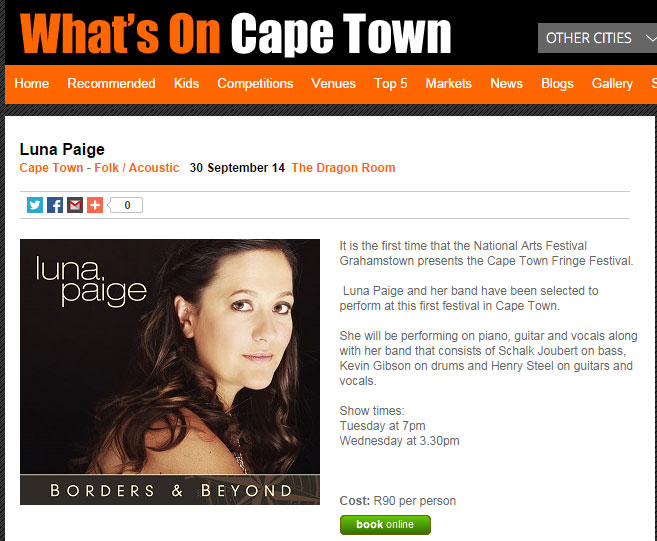
Example: Whatson.co.za event listing
Many radio stations and even newspapers have websites where you can actually add your gigs into their database yourself. It is checked by editorial staff for accuracy and to ensure that it isn’t spam, but this is a great way to make sure word of your shows gets out.
You can also increase this media database to include music writers at magazines and other media outlets, and you can send your press releases and news stories to them as well. You will find that once you start doing this, the journalists will start coming to your shows as well. This is how a media profile can be developed using your gig and news information intelligently.
Originally published in David Chislett's One, Two, One, Two: A Step By Step Guide To The South African Music Industry. Download a free copy of the book at www.davidchislett.co.za.

[David Chislett]
David Chislett is a multi-talented South African speaker and writer. He graduated to national radio in 1994 when Barney Simon used him as a live radio correspondent on 5FM from London. David delivers a key note address, “Unleash Your Inner Rockstar” with Martin Schofield which teaches the hidden secrets of success from the music industry to businesses.